-
April
Planting!
Info taken from emails from: https://nogridsurvivalprojects.com
subscribe to this awesome resource!!!
From 2023 – No Grid Survival Projects
My mailing address is:No-Grid Survival Projects, 2549 Waukegan RD , PMB 45933, BANNOCKBURN, Illinois 60015-1569, United States
Years ago, I decided to start a compost for the first time. Not really understanding just how composting worked, I took a bowl of scraps I collected in my kitchen and dumped them into a plot of dirt I had on the side of my home. This happened in the fall when red and gold leaves covered the grounds of our property.
A few months later, in the dead of winter, there were tall new stalks in the same plot where I had naively dumped my kitchen scraps. Upon taking a closer look, I was able to determine precisely what the new growth was. They were leeks. Lots of beautiful, fresh leeks!
This very unexpected gift of growth set me out on a journey to find out what else I would be able to grow from scraps successfully. It turns out you can produce quite a large variety of foods by using their scraps or seeds from items bought in-store or at your local farmers’ market.Growing From Seed
The next time you find yourself scooping out the seeds from your squash or melon, don’t be too fast to throw them in the compost! Instead, carefully clean the fibers away from the seeds and dry the seeds on a paper towel.
Once the seeds are dried, you can store and use them to plant your selected fruit or vegetables at the next optimal time. The best place to protect your seeds and other foods from heat, moisture, sunlight, and pests is an underground cellar. If you don’t have one already, this is the secret to building a small root cellar in your backyard for under $400.
Drying and storing seeds from store-bought or market-bought items work well with just about any member of the Gourd family, including melons, pumpkins, cucumbers, and zucchini.
Tomatoes grow from seed, of course; often by accident!Much like my personal experience with the intense growth of leeks in the winter, I’ve had the pleasure of being told the tale of the surprise tomato bushes.
Tomato lovers toss an overripe tomato outside, or a child indulges in cherry tomatoes in the garden, and a few weeks later, property owners are blessed with beautiful fragrant tomato plants that quickly bear an abundance of fruit throughout the season.
Growing From Cut Tops
While preparing beets, draw up some water in a shallow dish and place the tops you sliced from the top of the vegetable, ensuring that the base of the beet greens is still attached. If changing the water in the shallow dish regularly, you will see regrowth in the beet greens.
The growth of the greens allows for two things; keep up with the maintenance of the beet tops to use the greens for cooking or using in salads, or plant the beets for regrowth.
This method works well for most root crops, such as radishes, turnips, carrots, and parsnips.
Herbs From Stalks And Fresh Cuts
Store-bought lemongrass can be pricey. That’s why it’s an exciting discovery for lovers of this fragrant herb when they realize how easy it is to make your purchase give you a supply for months to come.
When using some of your store-bought lemongrass, be sure to save a piece of the stalk with some of the roots attached. Place the remaining stalk in a jar, submerge the roots in freshwater, and place it in direct sunlight. New growth will begin to develop on the stalks within a few days. When changing the water regularly, the roots will start to develop further.
After a week or so, you can plant your stock and its newly developed roots in a soil-rich garden bed or pot. New stalks of lemongrass will grow over the coming weekends, easily doubling the amount of what you initially purchased.This regrowth of roots from stalks works exceptionally well with celery, scallions, shallots, and garlic. However, note that frequent water change is essential, as rot can set in quickly.
Whatmore, similar steps can be taken to grow herbs from fresh cuts. Place freshly cut or purchased herbs in a glass with clean water. Change out the water regularly, and your fresh cuts will begin to sprout roots at their base!
After allowing the roots to grow about one inch in length, your herbs are ready to plant and will give you new, beautiful bounties of herbs for use in your kitchen.
Thyme, basil, rosemary, marjoram, coriander – you can grow whatever your heart desires!Good ‘Ol Spuds
Those potatoes are beginning to sprout. Quick: plant them!
Potatoes quickly grow from older spuds that have developed eyes or sprouted. Allow the sprouts on your potatoes to grow around one to two inches long and plant in rich soil. Potatoes take up a lot of space underground. Many gardeners prefer to place potatoes in large planters or even large bins for easy harvest.
Sweet potatoes don’t sprout as easily as potatoes without a bit of push. Take an aging sweet potato and cut it in half. Suspend the sweet potato in a jar allowing only the uncut side of the sweet potato to be submerged in water without touching the bottom of the jar. After a few days, roots will develop in the water, and new sprouts/eyes will develop at the top.After the tops and bases have grown an inch or two, your sweet potato is ready to plant in the garden. TIP: Collect a variety of jars and shallow dishes and create a “lab” by a window that receives direct sunlight.
Bon Appetit!
Once preparing food in the kitchen, you’ll be able to quickly and seamlessly place scraps in their appropriate containers and begin to experiment with regrowth without having to put too much thought or focus on the set-up itself.
The amount of crops that you can produce from scraps is astounding. Growing crops from scraps is a preferred method of growing comestibles for many homesteaders and gardeners.
Even more exciting, you can put this practice to use for non-comestibles to help you create your flower garden, but we’ll save that conversation for another time.1. Food, Water, Snacks, Desserts
We are going to leave this to you to make your own list but start with your sever favorite meals x4 and have months worth on top of your random storage. Make sure to add chia and flax and micro greens.
2. Power, energy, heating, cooling
- A network of neighbors, ward members, family and friends with a power out plan. Everyone has certain skills, assignments and abilities. Use proximity to create a web. Ex: engineer, welder, wood worker, mechanic, plumber, electrician, seamstress, doctor, counselor, teacher, baker etc…
- a network of cast iron pans and skillets
- bike, bike parts, cart
- bags and containers
- wood items
- tin foil (windows will absorb heat when no ac)
- homemade ice cooler (we will figure the details in a future class
- outdoor solar camp shower with privacy
- solar cell charger
- walkie talkies/landlines
- batteries ( odd sizes too)
- generators… multiple and multiple kinds.. and test often
- fuel (ways to store in future class) and propane
- wood stove
- fireplace
- brikets
- matches
- lighters
- camping stove
- terra cotta candle and other home made heat sources ( we will investigate)
- wood
- timer, analog clock
- compost toilet/outhouse and tp options
- solar panels
- roof and drywall repair
- small plumbing/heating/cooling and thermostat repair
- new kinds of fire extinguishers
- safety pins and sewing kits
- smoke detectors and carbon monoxide detectors
- glass containers
- plastic water jugs
3. Cleaning supplies and tools
- baking powder and soda
- vinigar
- apple cider vinigar
- alcohol
- bleach
- basic tools x2
- basic yard tools x2
- chain saw
- several can openers and heavy duty scissors
- twisty ties all forms of tape and glue
- many forms knives and sharpeners
- wheel barrow , hoses and basic gardening tools and containers
- contractor bags, kitchen bags, groceries bags, freezer bags
- masks and gloves
- DW-40
- Dish soap, liquid hand soap, bar soap, concentrated cleaner, stain removers, Castile soap
- flat iron, milar bags,
3. Hygiene/ Medical/Herbs and Supplements/ Cosmetics/ infant care and women’s health
- snake or spider bite kit
- CPR and first aid products, training and quick guides
- many bandages, prescriptions
- T.P. sanitary wipes, pads, tampons, birth control
- washcloths, old towels, cheese cloth and flour bag towels
- floss, toothpaste, brushes, instrument to clean your families teeth, mouthwash
- lotion, body soap, razors, deodorant, sunscreen
- clippers, tweezers x2
- many extra contacts, glasses, contact solution
- life-straw bottles
- herbs, essential oils (oregano, basil, peppermint, hellichrism, ginger, tea tree, frankincense, lavender, Digestzen (Doterra)
- meds like cold and flu, cranberry pills, charcoal, Tums, Pesto
- vit D, magnesium and potassium, CBD, aloe plant, pain killer, valerian root, melatonin, calcium lactate, birch oil
- diapers, wipes, rash cream
- Waxalene, pine gum salve, Burtsbees, coconut
- pest control supplies
- hair cutting set
- things specifically for your use (heel lift, arch support, moleskin, hearing aides)
Entertainment, office supplies, art and craft supplies, books, education
- prints out of art to copy gets inspiration from
- art supplies, watercolor, craft paint
- tons of paper, pens, eraser, paper and manual sharpeners
- office supplies
- balls
- books on how to and fun stuff (DK and Kingfisher)
- cards, games, puzzles
- sewing stuff
- sharpies, thin and thick
- paint brushes
- recipes and substitutes printed out
- firebox
-
March
Meals in a Jar
From: No Grid Survival Projects:
Currently, economic fallout is one of the most likely ways things can go wrong for humanity. The impact of a financial crisis is significant in terms of monetary losses and human suffering. While we may not be able to avoid the full impact of this widespread issue, there are things we can do to prepare.
One of the first places a recession is felt is in food access. A grocery bill that was once manageable is now astronomical. A simple trip to the grocery store has increased in cost, and many people find it challenging to make ends meet, let alone feed their family a healthy, balanced diet.
Thankfully, if you start now, you can prepare for things getting really tough. While stocking up on toilet paper, canned goods, medications, and essentials is always a good idea; you need to consider the bigger picture. Canned beans and survival crackers are not a long-term solution.
The effects of any type of crisis could last for weeks or even years, but life will inevitably continue. If you hope to be able to live in a relatively normal state, you will want to have healthy, hearty meals on hand.
The good news is that you can create these meals today while you can still afford the ingredients. Preparing now means you will have meals on hand later if you are in a situation where you can’t afford to buy food or cannot safely access it.
Here are some easy-to-prepare meals that can be stored for extended periods, so you are ready when things go bad.Turkey Dinner In A Jar
• 1 cup freeze dried turkey;
• 5-7 tbsp chicken or turkey gravy powder;
• 1-2 cups seasoned stove top stuffing;
• dehydrated vegetables;
• salt and pepper.
Layer the ingredients in a large mason jar, vacuum seal, or add an oxygen absorber. Store until needed.
Cooking Directions:
To make this meal, boil 4 cups of water and add the mixture from the jar. Let stand for approximately 10 minutes, adding more water if required. Simmer this meal for 20 minutes, allowing it to soften and the flavors to absorb.Tacos In A Jar
Tuesday night tacos become so easy with a stored dry mix.
Ingredients:• 2-3 tbsp taco seasoning;
• 2 tbsp tomato powder
• freeze-dried onions, beans, corn and other vegetables;
• dried chilis or pepper flakes;
• ½ cup freeze-dried hamburger.
⇒ Click Here To Learn How To Can Hamburger Meat For Long Term Preservation
Layer all ingredients in a mason jar and seal. Add an oxygen absorber if you are not using a pressure canner. Store in a spot that is away from heat and light.
Cooking Directions:
Dump the mixture into a pot and add 6-8 cups of water. Bring the mix to a rapid boil, then turn the heat to medium for 15-minutes to thoroughly cook the beans. Add more seasoning if required.
A longer simmer will create a thicker mix. Serve with tortilla chips or put it on a taco shell with sour cream and salsa if they are available. You can also eat this meal as a taco soup by increasing the water and creating more liquid.Super Simple Sloppy Joe’s
Sloppy Joe’s are always a family favorite and easy to make. In a crisis, you can still enjoy this favored meal if prepared ahead of time.
Ingredients:1 cups ground beef;
• ½ cup each peppers;
• ¼ cup each freeze-dried celery, corn, and tomato powder;
• 3-4 tbsp Sloppy Joe’s flavoring powder
Layer all ingredients in a mason jar and vacuum seal using a pressure canner.
Cooking Directions:
Boil 4 cups of water in a saucepan. Add the mixture to the water and reduce heat to medium. Simmer for 25-30 minutes. Serve on hamburger buns for a filling, flavorful meal. If fresh bread is not readily available, this meal is also great on its own or served over crushed tortillas.
You can create extra sloppy joe sauce by combining minced onion, garlic, dry mustard, celery salt, and chili powder in another container and adding water when you are ready to serve. Put these ingredients in a baggy and store them within the jar for easy access later.
You already know that garlic is especially healing. It has been used to treat all kinds of illnesses and infections over the past centuries. It numbs the pain while treating the underlying infection. But do you know what happens when you pour honey over garlic?Mac And Cheese In A Jar
Mac and cheese is the ultimate comfort food, which may come in handy during a crisis when tensions are high. This simple storage version of a favorite family classic is perfect for your preparedness kit.
Ingredients:• cheese powder;
• butter powder;
• milk powder;
• salt and pepper;
• elbow macaroni.
Add dry ingredients to a plastic baggy and vacuum seal, or remove as much air as possible. Fill a jar ¾ of the way with elbow macaroni and place the dry ingredients baggy on top. Add an oxygen absorber.
Vacuum seal the jar or allow the oxygen absorber to do its thing and wait for the jar to seal itself. Store the jar in a dark, dry place until needed.
Cooking Directions:
Remove plastic baggy and set aside. Add elbow macaroni to a pot of boiling water and cook for 8-10 minutes. Once the pasta is cooked, set aside approximately ½ – ¾ cups of the pasta water.
Drain the remaining water from the pasta and return it to the pot. Pour ½ a cup of the pasta water back into the pot and add the dry ingredients from the baggy. Stir until thick and cheesy, adding more water if required.
You can use other kinds of pasta, but cooking times will vary. You may also want to add some freeze-dried veggies to make this meal more nutrient-rich.Taste Of Texas Chili
Chili is the perfect meal on a crisp fall day, and it is also an excellent option for a stored meal that is easy and affordable to create. The best part is that it is fully cooked and ready to serve or store.
Ingredients:
• 1 can of kidney beans, drained or two cups of dried beans, cooked and drained;
• 1-1 ½ lbs ground beef;
• 1 onion or dried onion flakes;
• 1-2 cloves of garlic or 1- 2 tsp garlic powder;
• 1 tsp oregano;
• 1 can of crushed tomatoes;
• 1 tbsp chili powder;
• 1-2 bell peppers, seeded and chopped;
• ½ a can of root beer;
• chili flakes and any other spices you like.
Cooking Directions:
Cook ground beef in a pan with onion, peppers, and spices. Add the ½ can of root beer to the meat halfway through cooking and continue until the meat is browned and the root beer is beginning to thicken a bit. Add the kidney beans and tomatoes, simmer for 10-15 minutes.
Pack the cooked chili into heated jars, leaving 1-inch of headspace. Wipe the rim, add the lid, and seal in a pressure canner for 1 ½ hour. Store in a spot that is dark and cool.What Are The Benefits Of Food Storage?
People often take for granted that they can go to the grocery store and purchase the items they need to create a healthy meal.
What happens if this ability were to vanish suddenly or if you simply didn’t have the money to purchase food? As you probably know, this is not such a far-fetched idea. The risk of impending doom makes having a stockpile that includes hearty meals essential. Storing food, especially ready-to-eat meals, is an excellent idea with many benefits.
A critical aspect of any prepper’s strategy, food storage can mean the difference between life and death. However, there are things to remember when looking to store foods for extended periods.
It is also essential to consider how many people you will be feeding, and it is a good idea to store extra food in case someone manages to access your stock, you fall ill, or something terrible happens.Learn to build a 5 year food stockpile:
https://lostknowledge.askaprepper.com/click.html?x=a62e&lc=tf&mc=1&s=bGB&u=u&z=JJfipWM&Years ago, I decided to start a compost for the first time. Not really understanding just how composting worked, I took a bowl of scraps I collected in my kitchen and dumped them into a plot of dirt I had on the side of my home. This happened in the fall when red and gold leaves covered the grounds of our property.
A few months later, in the dead of winter, there were tall new stalks in the same plot where I had naively dumped my kitchen scraps. Upon taking a closer look, I was able to determine precisely what the new growth was. They were leeks. Lots of beautiful, fresh leeks!
This very unexpected gift of growth set me out on a journey to find out what else I would be able to grow from scraps successfully. It turns out you can produce quite a large variety of foods by using their scraps or seeds from items bought in-store or at your local farmers’ market.1. Food, Water, Snacks, Desserts
We are going to leave this to you to make your own list but start with your sever favorite meals x4 and have months worth on top of your random storage. Make sure to add chia and flax and micro greens.
2. Power, energy, heating, cooling
- A network of neighbors, ward members, family and friends with a power out plan. Everyone has certain skills, assignments and abilities. Use proximity to create a web. Ex: engineer, welder, wood worker, mechanic, plumber, electrician, seamstress, doctor, counselor, teacher, baker etc…
- a network of cast iron pans and skillets
- bike, bike parts, cart
- bags and containers
- wood items
- tin foil (windows will absorb heat when no ac)
- homemade ice cooler (we will figure the details in a future class
- outdoor solar camp shower with privacy
- solar cell charger
- walkie talkies/landlines
- batteries ( odd sizes too)
- generators… multiple and multiple kinds.. and test often
- fuel (ways to store in future class) and propane
- wood stove
- fireplace
- brikets
- matches
- lighters
- camping stove
- terra cotta candle and other home made heat sources ( we will investigate)
- wood
- timer, analog clock
- compost toilet/outhouse and tp options
- solar panels
- roof and drywall repair
- small plumbing/heating/cooling and thermostat repair
- new kinds of fire extinguishers
- safety pins and sewing kits
- smoke detectors and carbon monoxide detectors
- glass containers
- plastic water jugs
3. Cleaning supplies and tools
- baking powder and soda
- vinigar
- apple cider vinigar
- alcohol
- bleach
- basic tools x2
- basic yard tools x2
- chain saw
- several can openers and heavy duty scissors
- twisty ties all forms of tape and glue
- many forms knives and sharpeners
- wheel barrow , hoses and basic gardening tools and containers
- contractor bags, kitchen bags, groceries bags, freezer bags
- masks and gloves
- DW-40
- Dish soap, liquid hand soap, bar soap, concentrated cleaner, stain removers, Castile soap
- flat iron, milar bags,
3. Hygiene/ Medical/Herbs and Supplements/ Cosmetics/ infant care and women’s health
- snake or spider bite kit
- CPR and first aid products, training and quick guides
- many bandages, prescriptions
- T.P. sanitary wipes, pads, tampons, birth control
- washcloths, old towels, cheese cloth and flour bag towels
- floss, toothpaste, brushes, instrument to clean your families teeth, mouthwash
- lotion, body soap, razors, deodorant, sunscreen
- clippers, tweezers x2
- many extra contacts, glasses, contact solution
- life-straw bottles
- herbs, essential oils (oregano, basil, peppermint, hellichrism, ginger, tea tree, frankincense, lavender, Digestzen (Doterra)
- meds like cold and flu, cranberry pills, charcoal, Tums, Pesto
- vit D, magnesium and potassium, CBD, aloe plant, pain killer, valerian root, melatonin, calcium lactate, birch oil
- diapers, wipes, rash cream
- Waxalene, pine gum salve, Burtsbees, coconut
- pest control supplies
- hair cutting set
- things specifically for your use (heel lift, arch support, moleskin, hearing aides)
Entertainment, office supplies, art and craft supplies, books, education
- prints out of art to copy gets inspiration from
- art supplies, watercolor, craft paint
- tons of paper, pens, eraser, paper and manual sharpeners
- office supplies
- balls
- books on how to and fun stuff (DK and Kingfisher)
- cards, games, puzzles
- sewing stuff
- sharpies, thin and thick
- paint brushes
- recipes and substitutes printed out
- firebox
-
Hey Sisters!
Welcome to the Farmington NM 5th ward Food Storage Blog! Please feel free to email or text me any links or info you find that you would like to share here with the other sisters. We are all learning!
1. Food, Water, Snacks, Desserts
We are going to leave this to you to make your own list but start with your sever favorite meals x4 and have months worth on top of your random storage. Make sure to add chia and flax and micro greens.
2. Power, energy, heating, cooling
- A network of neighbors, ward members, family and friends with a power out plan. Everyone has certain skills, assignments and abilities. Use proximity to create a web. Ex: engineer, welder, wood worker, mechanic, plumber, electrician, seamstress, doctor, counselor, teacher, baker etc…
- a network of cast iron pans and skillets
- bike, bike parts, cart
- bags and containers
- wood items
- tin foil (windows will absorb heat when no ac)
- homemade ice cooler (we will figure the details in a future class
- outdoor solar camp shower with privacy
- solar cell charger
- walkie talkies/landlines
- batteries ( odd sizes too)
- generators… multiple and multiple kinds.. and test often
- fuel (ways to store in future class) and propane
- wood stove
- fireplace
- brikets
- matches
- lighters
- camping stove
- terra cotta candle and other home made heat sources ( we will investigate)
- wood
- timer, analog clock
- compost toilet/outhouse and tp options
- solar panels
- roof and drywall repair
- small plumbing/heating/cooling and thermostat repair
- new kinds of fire extinguishers
- safety pins and sewing kits
- smoke detectors and carbon monoxide detectors
- glass containers
- plastic water jugs
3. Cleaning supplies and tools
- baking powder and soda
- vinigar
- apple cider vinigar
- alcohol
- bleach
- basic tools x2
- basic yard tools x2
- chain saw
- several can openers and heavy duty scissors
- twisty ties all forms of tape and glue
- many forms knives and sharpeners
- wheel barrow , hoses and basic gardening tools and containers
- contractor bags, kitchen bags, groceries bags, freezer bags
- masks and gloves
- DW-40
- Dish soap, liquid hand soap, bar soap, concentrated cleaner, stain removers, Castile soap
- flat iron, milar bags,
3. Hygiene/ Medical/Herbs and Supplements/ Cosmetics/ infant care and women’s health
- snake or spider bite kit
- CPR and first aid products, training and quick guides
- many bandages, prescriptions
- T.P. sanitary wipes, pads, tampons, birth control
- washcloths, old towels, cheese cloth and flour bag towels
- floss, toothpaste, brushes, instrument to clean your families teeth, mouthwash
- lotion, body soap, razors, deodorant, sunscreen
- clippers, tweezers x2
- many extra contacts, glasses, contact solution
- life-straw bottles
- herbs, essential oils (oregano, basil, peppermint, hellichrism, ginger, tea tree, frankincense, lavender, Digestzen (Doterra)
- meds like cold and flu, cranberry pills, charcoal, Tums, Pesto
- vit D, magnesium and potassium, CBD, aloe plant, pain killer, valerian root, melatonin, calcium lactate, birch oil
- diapers, wipes, rash cream
- Waxalene, pine gum salve, Burtsbees, coconut
- pest control supplies
- hair cutting set
- things specifically for your use (heel lift, arch support, moleskin, hearing aides)
Entertainment, office supplies, art and craft supplies, books, education
- prints out of art to copy gets inspiration from
- art supplies, watercolor, craft paint
- tons of paper, pens, eraser, paper and manual sharpeners
- office supplies
- balls
- books on how to and fun stuff (DK and Kingfisher)
- cards, games, puzzles
- sewing stuff
- sharpies, thin and thick
- paint brushes
- recipes and substitutes printed out
- firebox
-
February 2023
5th meeting Wish List!
This week we are making a list of absolutely every single thing we cant think of that we would want to have stored if we could not get to a store for 6 months, or maybe even a year. Keep this running list and next time you feel the urge to shop just for the sake of shopping, pull this out and put down the nonsense! You may really thank yourself later.
This is list goes beyond survival. This is more like comfort, peace and some joy! So in the Valentine spirit of love, chocolate and indulgence… lets make your wish list! Probably non of us have the $ for all this anytime soon, nor are we encouraging debt or overspending. This is a list to keep on hand and to slowly work through over a long period of time… maybe a lifetime.
Think: What was my “Oh Crap” moment when Covid hit? What did I panic that I might not be able to get that would have been really uncomfortable to not have? I don’t care how “prepared” you were… I know you had that.
boxes of contacts (or in my case.. why have I not gotten Lasik yet?)
birth control? Seriously!!!!!!
drawing paper for my kids……
what about simple ingredients that make up most hygiene, cleaning supplies and life hacks like vinegar, baking soda, and coconut oil?
What would you want and need if you could survive at home without trucks coming in for a year. Maybe you have enough water and food… but what else so you are not miserable? If you can store it now and work on getting it, why not be less miserable? And what if trucks are running and the world is still turning but one of you lose your job or someone is sick? What would make all the difference? We are not thinking fear tonight though, we are thinking abundance!!!
We are going to separate into groups to cover a few areas and then list everything together in a master list:
1.food/water/snacks/deserts
2.power/energy/heat/cooling
3.cleaning supplies and tools
4.hygiene/medicine/herbs/oils/supplements/cosmetic/infant care/women’s health
5.clothing/bedding/shoes for all weather
6.entertainment for adults and kids/office supplies/art/craft supplies/books/education
1. Food, Water, Snacks, Desserts
We are going to leave this to you to make your own list but start with your sever favorite meals x4 and have months worth on top of your random storage. Make sure to add chia and flax and micro greens.
2. Power, energy, heating, cooling
- A network of neighbors, ward members, family and friends with a power out plan. Everyone has certain skills, assignments and abilities. Use proximity to create a web. Ex: engineer, welder, wood worker, mechanic, plumber, electrician, seamstress, doctor, counselor, teacher, baker etc…
- a network of cast iron pans and skillets
- bike, bike parts, cart
- bags and containers
- wood items
- tin foil (windows will absorb heat when no ac)
- homemade ice cooler (we will figure the details in a future class
- outdoor solar camp shower with privacy
- solar cell charger
- walkie talkies/landlines
- batteries ( odd sizes too)
- generators… multiple and multiple kinds.. and test often
- fuel (ways to store in future class) and propane
- wood stove
- fireplace
- brikets
- matches
- lighters
- camping stove
- terra cotta candle and other home made heat sources ( we will investigate)
- wood
- timer, analog clock
- compost toilet/outhouse and tp options
- solar panels
- roof and drywall repair
- small plumbing/heating/cooling and thermostat repair
- new kinds of fire extinguishers
- safety pins and sewing kits
- smoke detectors and carbon monoxide detectors
- glass containers
- plastic water jugs
3. Cleaning supplies and tools
- baking powder and soda
- vinigar
- apple cider vinigar
- alcohol
- bleach
- basic tools x2
- basic yard tools x2
- chain saw
- several can openers and heavy duty scissors
- twisty ties all forms of tape and glue
- many forms knives and sharpeners
- wheel barrow , hoses and basic gardening tools and containers
- contractor bags, kitchen bags, groceries bags, freezer bags
- masks and gloves
- DW-40
- Dish soap, liquid hand soap, bar soap, concentrated cleaner, stain removers, Castile soap
- flat iron, milar bags,
3. Hygiene/ Medical/Herbs and Supplements/ Cosmetics/ infant care and women’s health
- snake or spider bite kit
- CPR and first aid products, training and quick guides
- many bandages, prescriptions
- T.P. sanitary wipes, pads, tampons, birth control
- washcloths, old towels, cheese cloth and flour bag towels
- floss, toothpaste, brushes, instrument to clean your families teeth, mouthwash
- lotion, body soap, razors, deodorant, sunscreen
- clippers, tweezers x2
- many extra contacts, glasses, contact solution
- life-straw bottles
- herbs, essential oils (oregano, basil, peppermint, hellichrism, ginger, tea tree, frankincense, lavender, Digestzen (Doterra)
- meds like cold and flu, cranberry pills, charcoal, Tums, Pesto
- vit D, magnesium and potassium, CBD, aloe plant, pain killer, valerian root, melatonin, calcium lactate, birch oil
- diapers, wipes, rash cream
- Waxalene, pine gum salve, Burtsbees, coconut
- pest control supplies
- hair cutting set
- things specifically for your use (heel lift, arch support, moleskin, hearing aides)
Entertainment, office supplies, art and craft supplies, books, education
- prints out of art to copy gets inspiration from
- art supplies, watercolor, craft paint
- tons of paper, pens, eraser, paper and manual sharpeners
- office supplies
- balls
- books on how to and fun stuff (DK and Kingfisher)
- cards, games, puzzles
- sewing stuff
- sharpies, thin and thick
- paint brushes
- recipes and substitutes printed out
- firebox
-
January 2023
4th Meeting with Carleene Nygren Guest Speaker!
Emergency Essentials 15 Tips for Food Storage Shopping
1.Learn what to look for.
2.Think in terms of calories per person per day.3.Look for nutritious calories, not empty calories.
4.Be informed about nutritional values
5.Do not rely entirely on number of servings
6.Be concerned about menu fatigue.
7.Be aware of weights and volumes
8.Know what kind of cook you are.
9.Scrutinize shipping and handling charges
10. Don’t just look at the price
11. Understand the pros and cons of the differentkinds of packaging.
12. Understand the difference between “freezedried” and “dehydrated” food – and be sure you’re not paying freeze dried prices for dehydrated products.13. Do not take promises of a 25-year shelf life at face value.
14. Know the facts about “year supplies” and large food storage “combos”.
15. Find a trusted supplier.
d
List from one who has lived through Sandy’s
lessons. Nothing we don’t know, but are weready?
A MUST WHEN AN EMERGENCY HITS!!!
(A friend from Oregon sent this to me beginning withthe following words)….
I’m sending this on to EVERYONE. I’m thankful that I
was sent this list so I’ll be better prepared. Please read
it, and take it to heart. They weren’t expecting this to
happen to them anymore than we expect it to happen tous.
Living through Sandy Hurricane
48 things you’ll want to know
By Frantz Ostmann November 17, 2012- The excitement and coolness wears off around day 3.
- You are never really prepared to go weeks without power, heat,
water, ect. NEVER! - Yes, it can happen to you.
- Just because your generator runs like a top, does not mean it’s
producing electricity. - If you do not have water stored up, you are in trouble. A couple of
cases of bottled water is “NOT” water storage. - Should have as much fuel as water
Gas
Kerosene
Firewood
Fire starter (kindling, paper, etc)- Even the smallest little thing that you get from the store should be
stocked up. (Spark plug for the generator, BBQ lighter, etc) - If you are not working, chances are nobody else is either.
- I was surprised how quickly normal social behavior goes out the
window. I am not talking about someone cutting in line at the
grocery store.
3 people were killed at a gas station within 50 miles of my home
I did not say 3 fights broke out, 3 people were killed. - Cash is king (all the money in your savings means nothing)
- Stored water can taste nasty
- You need more food than you think if your kids are out of
school for 2 weeks. - Kids do not like washing their face in cold water.
- You eat a lot more food when you are cold.
- Your 1972 Honda Civic gets to the grocery store as well as
your 2012 Escalade . . . . but the Honda allows money left over
for heat, food, water, a generator, fire wood, a backup water
pump, you get the idea. - The electrical grid is way more fragile than I thought.
- Think of the things that are your comfort, your escape. A cup of
hot chocolate, a glass of milk, a ding dong before bed, etc. Stock
upon those too. You will need that comfort after day 3. - You quickly become the guy in the neighborhood who knows
how to wire a generator to the electrical panel, directly wire the
furnace to a small generator, or get the well pump up and running
on inverter power or you are the guy whose Master’s degree in
Accounting suddenly means nothing (Love you Steve!) - A woman who can cook a fine meal by candle light over the
BBQ or open fire is worth her weight in gold. And women, whose
weight in gold would not add up to much, usually die off first.
Sorry skinny women. - It takes a lot of firewood to keep a fire going all day and into
the evening for heat. - All the food storage in the world means nothing if your kids
won’t eat it. - You might be prepared to take care of your children and their
needs, but what about when your neighborhood children start to
show up at your door? - Some people shut down in an emergency. There is nothing you
can do about that. - Your town, no matter how small, is entirely dependent on
outside sources of everything. - If supply trucks stop rolling in due to road damage, gas
shortages or anything else you could be without for a long time. - In an emergency Men stock up on food, Women stock up on
toilet paper. - I was surprised how many things run on electricity.
- You can never have enough matches.
- Although neighbors can be a great resource, they can also be
a huge drain on your emergency storage. You need to know how
you are going to handle that. It’s really easy to be Bob the guy
who shares on Day 3, not so easy on Day 11. This is just reality
speaking. - Give a man a fish he eats for that day, teach a man to fish and
he will never be hungry again… now I get it. - All of the expensive clothes in my closet mean nothing, if they
don’t keep you warm. - Same goes for shoes
- You cannot believe the utility companies. They are run by
politicians!!! Or so it seems - Anything that you depend on someone else for is not available
anymore. - Quote “A man with a chainsaw that knows how to use it, is a
thing of beauty” - Most folks don’t have any emergency storage. They run to
Wal-Mart and get water and batteries and then fill their tubs with
water. That is it. A lucky few will get a case of ramen and a box of
pop tarts. That will be your neighbor’s supply. (Especially if you
live outside of Utah)- Fathers, all the money you have ever made means nothing if
you can’t keep your kids warm. - Mothers, everything you have ever done for your kids is
forgotten if your kids are hungry. - You really do not want to be the “Unprepared Parents” The kids
turn on you pretty quick. - Small solar charging gadgets will keep you in touch. Most work
pretty well it seems. - Most things don’t take much power to operate.
Computers
Phones
Radios
TV
Lights - Some things take a ton of power to operate.
Fridge
Toaster
Freezer
Hot Plate
Microwave - When it gets dark at 4:30 pm the nights are really long without
power. - Getting out of the house is very important, even if it is cold
outside. Make your home the semi warm place to come home to,
and not the cold prison that you are stuck in. - Someone in your family must play or learn to play guitar.
- Things that disappear never to be seen again for a very long
time:
Fuel, all kinds
Matches, lighters of any kind, etc
Toilet Paper
Paper plates, plastic utensil
Batteries – didn’t really see a need for them. (How about
flashlights???? I guess)
Milk
Charcoal
Spark plugs (generators)
2 stroke motor oil (chainsaws)
Anything that could be used to wire a generator to the house
Extension cords
Medicines (Tylenol, Advil, cold medicine, etc)- There was a strange peace to knowing all I had to do each day
was keep my family safe, warm and fed, but my peace was
someone else’s panic. - There were also many things that were not learned from
Hurricane Sandy, but reinforced. Those things were the
importance of my family and their love and support, especially my
lovely wife, that my Heavenly Father is really in charge, period,
and finally that I am very thankful for the upbringing and
experiences that have taught me and brought me to where I am .
. . Wherever that is. . . .lol God Bless!!!
1. Food, Water, Snacks, Desserts
We are going to leave this to you to make your own list but start with your sever favorite meals x4 and have months worth on top of your random storage. Make sure to add chia and flax and micro greens.
2. Power, energy, heating, cooling
- A network of neighbors, ward members, family and friends with a power out plan. Everyone has certain skills, assignments and abilities. Use proximity to create a web. Ex: engineer, welder, wood worker, mechanic, plumber, electrician, seamstress, doctor, counselor, teacher, baker etc…
- a network of cast iron pans and skillets
- bike, bike parts, cart
- bags and containers
- wood items
- tin foil (windows will absorb heat when no ac)
- homemade ice cooler (we will figure the details in a future class
- outdoor solar camp shower with privacy
- solar cell charger
- walkie talkies/landlines
- batteries ( odd sizes too)
- generators… multiple and multiple kinds.. and test often
- fuel (ways to store in future class) and propane
- wood stove
- fireplace
- brikets
- matches
- lighters
- camping stove
- terra cotta candle and other home made heat sources ( we will investigate)
- wood
- timer, analog clock
- compost toilet/outhouse and tp options
- solar panels
- roof and drywall repair
- small plumbing/heating/cooling and thermostat repair
- new kinds of fire extinguishers
- safety pins and sewing kits
- smoke detectors and carbon monoxide detectors
- glass containers
- plastic water jugs
3. Cleaning supplies and tools
- baking powder and soda
- vinigar
- apple cider vinigar
- alcohol
- bleach
- basic tools x2
- basic yard tools x2
- chain saw
- several can openers and heavy duty scissors
- twisty ties all forms of tape and glue
- many forms knives and sharpeners
- wheel barrow , hoses and basic gardening tools and containers
- contractor bags, kitchen bags, groceries bags, freezer bags
- masks and gloves
- DW-40
- Dish soap, liquid hand soap, bar soap, concentrated cleaner, stain removers, Castile soap
- flat iron, milar bags,
3. Hygiene/ Medical/Herbs and Supplements/ Cosmetics/ infant care and women’s health
- snake or spider bite kit
- CPR and first aid products, training and quick guides
- many bandages, prescriptions
- T.P. sanitary wipes, pads, tampons, birth control
- washcloths, old towels, cheese cloth and flour bag towels
- floss, toothpaste, brushes, instrument to clean your families teeth, mouthwash
- lotion, body soap, razors, deodorant, sunscreen
- clippers, tweezers x2
- many extra contacts, glasses, contact solution
- life-straw bottles
- herbs, essential oils (oregano, basil, peppermint, hellichrism, ginger, tea tree, frankincense, lavender, Digestzen (Doterra)
- meds like cold and flu, cranberry pills, charcoal, Tums, Pesto
- vit D, magnesium and potassium, CBD, aloe plant, pain killer, valerian root, melatonin, calcium lactate, birch oil
- diapers, wipes, rash cream
- Waxalene, pine gum salve, Burtsbees, coconut
- pest control supplies
- hair cutting set
- things specifically for your use (heel lift, arch support, moleskin, hearing aides)
Entertainment, office supplies, art and craft supplies, books, education
- prints out of art to copy gets inspiration from
- art supplies, watercolor, craft paint
- tons of paper, pens, eraser, paper and manual sharpeners
- office supplies
- balls
- books on how to and fun stuff (DK and Kingfisher)
- cards, games, puzzles
- sewing stuff
- sharpies, thin and thick
- paint brushes
- recipes and substitutes printed out
- firebox
-
November 2022
3rd Meeting
All about Water
The human body requires a minimum of one quart of water per day just to sustain life. A healthier recommendation is drinking two quarts of water each day. I personally drink almost a gallon a day!
Do Not:
The number one thing to know about water is that it should be stored just liked food: cool, dark, dry place for longevity and taste. Water should not be stored directly on cement and dirt. This causes corrosion. Instead, store on metal or wood. I stored water in clear collapsable bags for water in a hot garage in in two months, my water went out on my street and I tried to use them. They smelled like pee and were not even usable for cleaner!
Avoid using plastics that may leach Bisphenol A (BPA) into the water which is a known endocrine disruptor. Plastic is permeable and should never be stored near gasoline, pesticides or similar substances. Store out of direct sunlight whenever possible.Milk jug type gallons will deteriorate sometimes within a year and leak.
My personal water storage consists of a few things:
*Each time I make a grocery order, I add 5 gallons of the Glacier water gallons with a handle sticker for delivery. We use them during our workouts, sports and trips. We refill them and label them as “cleaner” so we know not to drink them later.
*55 gal blue drums ( I ordered metal holders on wheels for them) and an attachment to get the water out. ?
*6 gallon containers (show example) that I ordered online. They have gone from $22 to $30 since Covid started. Handle and spout for convenience.
*We also have several life straws and life straw water bottles.
*other water filters ]=
*Goal: small cistern tanks in back of house because my house can’f have a well because I am on a hill.
Container Supply in Ogden Utah sells containers at cost because they sell to large companies, the government will not let them advertise to the public but they can sell to the public. We can look into getting a large shipment or pickup. Half the price of what we are paying elsewhere. It also has containers for gasoline that are metal and very good to have.
For example: my container I just bought on Amazon was around $30. My friend got hers at Container Supply for $12!
Different types of water storage containers:
55 gal drums
Water bricks stackable and awesome but expensive
5 gallon stackable containers
Gallons of drinking water in the clear thick plastic
Glass jars that you collect (wont work for me)
$400 for 160 gallon tank
Outdoor cisterns range around $1000 depending on size
If you have a water filter you don’t need to necessarily rotate every 1 to 2 years, and tap water already has chlorine in it and you shouldn’t need to add any extra chlorine to the water storage. When water gets old it will taste flat or bad but sometimes putting oxygen into the water by shaking it around and putting air into it will make it taste better. Or just run it through the water filter and it tastes better than as well.
How to get water ready to drink after it has been sitting
Boiling
Filtering
Tablets
Clorox
Shake up!
Steps to Store Water for an Emergency
1. Clean container with a bit of dish soap and hot water.
2. Rinse all soap out of container.
3. Rinse the container with 1/2 tsp. of non-scented bleach and 1 quart of water.
4. Rinse bleach out.
5. Fill container with tap water.
6. Optional: Extend the length of time the water will stay fresh with alkaline drops.
Everything you need to know is at this link:
Also:
http://foodstoragemadeeasy.net/2015/02/11/food-storage-week-5-water/
How to Store Water Long Term: 12 Steps (with Pictures) – wikiHow
I used Ion Alkaline Water Treatment Drops (Amazon Ad: https://amzn.to/3uvxHiN) to keep my water fresh for up to 6 years.
6 Gallon Water Storage Containers on Amazon (Ad): https://amzn.to/3B4msis
LifeStraw Personal Water Filter for Hiking, Camping, Travel, and Emergency Preparedness https://a.co/d/ianSerF
LifeStraw Go Water Filter 22 oz Bottle with 2-Stage Integrated Filter Straw for Hiking, Backpacking, and Travel https://a.co/d/bGIxF9M
https://www.tractorsupply.com/tsc/catalog/water-storage-tanks
Highlight, copy and paste all your favorite info and add to binder!
Not water related:
Answers to questions from past classes: (very important)
One of our sisters had bugs in a plastic wheat bucket that she opened. How do we prevent this?
Use 9 ml thick plastic buckets only with thick mylar bags that are heat sealed with a flat iron and OA’s (Oxygen Absorbers).
In Egypt the Joseph’s people stored spelt with airflow and were able to sprout it. So…do NOT put all your grains with OA’s because then they wont sprout and you need to leave some grains/beans to sprout for your veggies/add vitamins and minerals and to add gut health to your breads (sour dough too). You can grow some of these together or apart. You can buy sprouting grains that come together for a variety of nutrition for emergency preparedness from
https://rainydayfoods.com/products/sprouting.html
You will want other grain flours to go in your bread because it is not cheap. But one 5 gallon bucket of seeds/grains that can be sprouted is said to be the equivalent of the nutrition needed from veggies for one adult for a year. This can cost $150 each, but what peace of mind!!!! Sprouts will save your health and you can toss them on sandwiches and soups and if you are lucky enough to have other produce, a salad!
Also, I found some answers to some questions about some biscuit mix going bad prematurely in a #10 can. It’s not something we would normally eat but had purchases for emergency through Thrive. The cans were puffy and had not been punctured. I found out it was because I stored them in my garage. You just can’t! But why are some of my other foods okay or at least seem to be okay? Because those mixes have oils in them that go rancid too. Also, it was not freeze dried. My freeze dried food like sausage has oils but still good for 20 years. Most of my long term food is worth half the nutrition they would have been and half the shelf life because of the heat!
Key take away: Move your junk out of your closets and to the garage or get rid of it. Ex: Seasonal clothing and decor. Fill your closets and under bed areas with life saving food. Really prioritize here!!!!!
1. Food, Water, Snacks, Desserts
We are going to leave this to you to make your own list but start with your sever favorite meals x4 and have months worth on top of your random storage. Make sure to add chia and flax and micro greens.
2. Power, energy, heating, cooling
- A network of neighbors, ward members, family and friends with a power out plan. Everyone has certain skills, assignments and abilities. Use proximity to create a web. Ex: engineer, welder, wood worker, mechanic, plumber, electrician, seamstress, doctor, counselor, teacher, baker etc…
- a network of cast iron pans and skillets
- bike, bike parts, cart
- bags and containers
- wood items
- tin foil (windows will absorb heat when no ac)
- homemade ice cooler (we will figure the details in a future class
- outdoor solar camp shower with privacy
- solar cell charger
- walkie talkies/landlines
- batteries ( odd sizes too)
- generators… multiple and multiple kinds.. and test often
- fuel (ways to store in future class) and propane
- wood stove
- fireplace
- brikets
- matches
- lighters
- camping stove
- terra cotta candle and other home made heat sources ( we will investigate)
- wood
- timer, analog clock
- compost toilet/outhouse and tp options
- solar panels
- roof and drywall repair
- small plumbing/heating/cooling and thermostat repair
- new kinds of fire extinguishers
- safety pins and sewing kits
- smoke detectors and carbon monoxide detectors
- glass containers
- plastic water jugs
3. Cleaning supplies and tools
- baking powder and soda
- vinigar
- apple cider vinigar
- alcohol
- bleach
- basic tools x2
- basic yard tools x2
- chain saw
- several can openers and heavy duty scissors
- twisty ties all forms of tape and glue
- many forms knives and sharpeners
- wheel barrow , hoses and basic gardening tools and containers
- contractor bags, kitchen bags, groceries bags, freezer bags
- masks and gloves
- DW-40
- Dish soap, liquid hand soap, bar soap, concentrated cleaner, stain removers, Castile soap
- flat iron, milar bags,
3. Hygiene/ Medical/Herbs and Supplements/ Cosmetics/ infant care and women’s health
- snake or spider bite kit
- CPR and first aid products, training and quick guides
- many bandages, prescriptions
- T.P. sanitary wipes, pads, tampons, birth control
- washcloths, old towels, cheese cloth and flour bag towels
- floss, toothpaste, brushes, instrument to clean your families teeth, mouthwash
- lotion, body soap, razors, deodorant, sunscreen
- clippers, tweezers x2
- many extra contacts, glasses, contact solution
- life-straw bottles
- herbs, essential oils (oregano, basil, peppermint, hellichrism, ginger, tea tree, frankincense, lavender, Digestzen (Doterra)
- meds like cold and flu, cranberry pills, charcoal, Tums, Pesto
- vit D, magnesium and potassium, CBD, aloe plant, pain killer, valerian root, melatonin, calcium lactate, birch oil
- diapers, wipes, rash cream
- Waxalene, pine gum salve, Burtsbees, coconut
- pest control supplies
- hair cutting set
- things specifically for your use (heel lift, arch support, moleskin, hearing aides)
Entertainment, office supplies, art and craft supplies, books, education
- prints out of art to copy gets inspiration from
- art supplies, watercolor, craft paint
- tons of paper, pens, eraser, paper and manual sharpeners
- office supplies
- balls
- books on how to and fun stuff (DK and Kingfisher)
- cards, games, puzzles
- sewing stuff
- sharpies, thin and thick
- paint brushes
- recipes and substitutes printed out
- firebox
-
October 2022
2nd meeting
Intro to Food Storage Methods, Nutrition, Shelf Life, Taste, Value, Store What You Want to Eat!
(DYI and Purchased Versions)
Canning (wet/dry)
Dehydrating
Freezing
Freeze Drying
Year Round and Seasonal Gardening
If you know a lot about a subject, we need you to explain as many details and tips as possible!
Follow up From Last weeks notes plus “What did you make happen in September?”
Wet Canning
What is it? Preserving wet food in glass jars with heat and pressure
Best things to can: most meat, fruit, veggies, chili, beans, soup
How? (who is an expert and can share brief outline)
Other methods: buying in aluminum cans (soup, beans, veggies, meats, fruit)
Nutrition : cans can have dangerous toxins. Jarred food is healthier because the glass is safe, but food must be cooked at high temps, destroying most nutrition.
Shelf Life: varies
Pros:
cheap (cost of food or free if grown and can be done without an expensive machine with basic supplies and glass jars with lids that are reusable)
Will fill your belly and add diversity to your food
Cons:
If done incorrectly at all, can cause botulism, high temps kill enzymes and a lot of nutrition, not easy to transport. Food canned in aluminum is not the healthiest. Glass is best.
What Items would you like to wet can if any?
Does this make sense for your situation?
Dry Canning and other packaging
What is it? Storing dried goods
What items are best stored dried?
All grains, legumes, rice, oats, pastas
Available to purchase pre canned: powdered cheese, butter, eggs, baking powder, baking sodas, corn meals, all grains.
How: Go through what you already have and heat seal with a straight iron
And/Or
Other methods: sealed buckets, mylar bags, glass jars, oxygen absorbers, spearmint gum, bay leaves
Nutrition: Nutrition and taste are best preserved if not ground up first. No heat needed. Store bought option of items like refried beans, powdered cheese, powdered potatoes etc. will often have several ingredients full of preservatives and disgusting and unnecessary fats. Read your labels and compare brands!!
Shelf Life: keep dry, cool, varies depending on prep and packaging. 1-30 years. Why such a variety of time?
One reason? Oil will cause it to go rancid quickly.
Pros: Vital part of food storage. Wheat can even be sprouted to make veggies all year indoors and sustain life.
Cons: Some pre- packaged brands can end up being completely un edible in flavor and full of fake garbage. DIY is the best choice where possible. Example: powdered sour cream brand I tried is not edible.
What Items would I like to dry can/package?
Does this makes sense for you? (The answer is yes.. it’s a a huge part of your staples)
Dehydrating
What is it? Hang drying or using an inexpensive machine to remove water.
What types of foods are typically dehydrated?
Fruit, fruit leathers, jerky, herbs and spices, tomatoes
How? Slice food thin, place on trays on an inexpensive machine. Jerky takes about 12 hours. You can even flatten ground beef into jerky if you don’t have a thin meat slicer. Make sure it is bone dry before storing
Other methods- some people have turned large old refrigerators into large dehydrators. Some use windows and cellars to hang dry. Anyone have experiences with these methods?
Nutrition – mixed opinions on nutrition retention! More calories for weight because of loss of water. Some sources claim no vitamin loss, while other sources claim vitamin loss.
Shelf Life- spices can last for decades. Meat… fruits last about a year if sealed up in glass and kept in a cool dark area. Every time you open the jar, the food is degraded. 60 degrees will give you a year and 80 degrees will give you 6 months. Vacuums seal for even better results.
Pros – cheap machine, great snacks and preserving herbs and spices from the garden
Cons –high energy cost, limited capacity, most things don’t have a super long shelf life?
What Items would like to dehydrate, if any?
Does this makes sense for you?
Freezing
What is it: Simply storing food in freezers (additionally, to what you have in your kitchen) with an additional power source and ideally after being vacuum sealed.
How? Cut up into small pieces and use small containers to breaking it up is easy. Vacuums seal your food first so that it does not freezer burn. This can give your food months, if not years extra.
Other methods: Use your freezer to temporarily store your food from a harvest or sale until you can store it in a longer and more dependable way. Buy previously prepared food or prepare on your own.
Nutrition : high retention of nutrients if foods are frozen shortly after harvest.
Shelf Life: indefinitely under zero degrees but in most cases, 6-12 months without being vacuum sealed before freezer burn sets in.
Freezer burned food, while gross, is actually safe to eat.
Pros: convenience, can be cheaper than fresh food and less pesticides and chemicals added, reduce waste, flexibility and can be precooked, is not usually picked before ripe
Cons: problems in the cooling chain can turn into health problems if not done right.
Counting on your food lasting from your freezer is not a sound idea without great generators and a way to continually power your generators.
Forgetting about your food in the freezer? Some suggestions from last class: Upright freezer, or a paper with freezer contents taped to it!
Again, watch labels for preservatives and avoid foods that are not whole.
Items I would like to freeze?
Does this makes sense for you?
Freeze Drying
What is it? Astronaut food! Keeps 97% nutrition, light weight, great for backpacking, can last up to 20 years. Buy it or make it yourself in an expensive machine. Can be reconstituted with water in various ways usually, or can be eaten dry. Either way, you will absolutely thrilled if this is all you have to eat nor to add to your plain dried bulk food.
How? About an hours worth of prep time every other day shopping food and setting up machine and cleaning it. A cycle takes about 24-30 hours. Then you seal the food as soon as it comes out of the trays warm only. A medium machine holds 7 lbs of food. Best results (and faster) if frozen first. Liquids and solids can be FD. You can freeze dry anything from almond milk to lasagna!
Things that would be kinda well…. dumb to Freeze Dry (to illustrate):
Chips, bread, cookies, rice with nothing else in it, any grain that could be otherwise stored by itself…..etc.
Other methods- You can buy it from many places like Thrive but although they claim to be healthy, just read most of the ingredients. Junk and so expensive. Yes, a machine is stupid expensive and just doubled since Covid, but because of the the waste elimination, the ability to freeze food you already have sitting in a freezer and can wait till things go on sale, it’s not as crazy as it seems. If you can’t afford it, buy one with a family member or save each month (do not go in to debt for one).
Nutrition- 97% nutrition retention and enhanced flavor in many foods because its concentrated.
Shelf Life – 20 plus years if done right
Pros – allows for huge variety in your storage, super tasty, amazing snacks and whole meals, eliminate almost all waste, pretty much solves world hunger in my opinion because there would be no waste and enough to share with everyone.
Cons- expensive, time consuming, must be done perfectly to last, large machines require professional electric work and uses about $3 day in electricity
can’t do: butter, peanut butter, syrup, honey, jelly, or chocolate (some extremely fatty things do not do well, although, I have successfully FD sausage and creamy/cheesy foods) Also, you will find yourself going in time periods where you just don’t get it done and you will feel guilty but also freak out when you realize you should have been freeze drying for the last couple decades of your life!
What Items would you like to Freeze Dry, if any? (List on back)
Does this makes sense for you?
Year round and Seasonal Gardening
This will all be discussed in depth on a later class, we are only introducing the concept tonight.
Hydroponics – growing plants in sand, gravel or liquid, with added nutrients but without soil. Inside or outside in store bought towers or hand made. Can be attached to timers, drips and are weedless and mostly maintains free. They require little water but you have to be able to buy the nutrients. You can purchase lights to grow year round food even in a dark basement!
Vertical Gardens/Green Wall… the process of going up rather than across the ground but can be done with soil or as a hydroponic on timers and with drips. The purpose of course is to save space and to be weedless. Also has the ability to be indoor with growing lights if needed. Sometimes you may have a sunny room, like I have but just need a boast for growth. Genius!!!
Raised beds and green houses
Raised beds are great for less weeds, controlling growth, look nice and mostly allow you to not have to bend over too much.
Shared Gardens
If you do not have land, go out of town often, are quite busy and need the load shared, consider a shared garden with a neighbor, family member or friend. You can also do a watering exchange with several other families so that your pots even get watered when you are away. There are young girls even in our ward that have grown gardens on decks of apartments, adjacent apartments and backsides of apartments with the permission of landlord. So inspiring!
We can list what we want to grow later in a future class but feel free to make notes on the back as they come!
Oh shoot, you have now run out of excuses? Me too!
Last Classes handouts…. Who needs them? Remember to purchase a a binder for all the handouts in this class.
How can we make this a document online so we have direct link access and can share links?
What is your October Food Storage Goal?
Links, books, resources ( please share)
“A better freeze drying group for the Harvest Right Freeze Dryer”
“ Harvest Right Freeze Dryers- Freeze Drying Adventures”
“Prepping, Homesteading and Bugging In”
https://www.buildastash.com/post/3-month-food-storage-list-lds
Class discussion notes from last week
We need to add 72 hour kits to the curriculum
Lets do preparedness projects together this summer or earlier
Focus on rotation
Who wants to schedule a trip to the cannery?
There are easy access long term storage 5 gal pest proof buckets called GAMA LIDs available at Home Depot and Shamrock (food grade)
Sugar doest need ox absorbers
Buy Molasses and make your own brown sugar. Better for you and molasses lasts longer than maple syrup
Morning Moos is a brand of powdered milk that actually tastes good! Available at Walmart in Durango and of course online
A milk strategy… half fresh and half powdered to get use to the taste
It’s time to stop being random with our storage and we will get to a specific 3 month menu soon
Make a list of what is in your freezer so you know what is lurking in there
If you put all your food in your fridge in glass and your pantry food, everything will last at least twice as long. That is a lot of savings! Start collecting and saving anything glass!!!
Buy a food saver. Not that much money compared to the savings on non wasted food.
Google: Super Cook, All Recipes Dinner Spinner, Big Oven, Magic Fridge,
These are all websites that you can put your inventory in and it will generate recipes with amounts. Freaky Genius!!!!
1. Food, Water, Snacks, Desserts
We are going to leave this to you to make your own list but start with your sever favorite meals x4 and have months worth on top of your random storage. Make sure to add chia and flax and micro greens.
2. Power, energy, heating, cooling
- A network of neighbors, ward members, family and friends with a power out plan. Everyone has certain skills, assignments and abilities. Use proximity to create a web. Ex: engineer, welder, wood worker, mechanic, plumber, electrician, seamstress, doctor, counselor, teacher, baker etc…
- a network of cast iron pans and skillets
- bike, bike parts, cart
- bags and containers
- wood items
- tin foil (windows will absorb heat when no ac)
- homemade ice cooler (we will figure the details in a future class
- outdoor solar camp shower with privacy
- solar cell charger
- walkie talkies/landlines
- batteries ( odd sizes too)
- generators… multiple and multiple kinds.. and test often
- fuel (ways to store in future class) and propane
- wood stove
- fireplace
- brikets
- matches
- lighters
- camping stove
- terra cotta candle and other home made heat sources ( we will investigate)
- wood
- timer, analog clock
- compost toilet/outhouse and tp options
- solar panels
- roof and drywall repair
- small plumbing/heating/cooling and thermostat repair
- new kinds of fire extinguishers
- safety pins and sewing kits
- smoke detectors and carbon monoxide detectors
- glass containers
- plastic water jugs
3. Cleaning supplies and tools
- baking powder and soda
- vinigar
- apple cider vinigar
- alcohol
- bleach
- basic tools x2
- basic yard tools x2
- chain saw
- several can openers and heavy duty scissors
- twisty ties all forms of tape and glue
- many forms knives and sharpeners
- wheel barrow , hoses and basic gardening tools and containers
- contractor bags, kitchen bags, groceries bags, freezer bags
- masks and gloves
- DW-40
- Dish soap, liquid hand soap, bar soap, concentrated cleaner, stain removers, Castile soap
- flat iron, milar bags,
3. Hygiene/ Medical/Herbs and Supplements/ Cosmetics/ infant care and women’s health
- snake or spider bite kit
- CPR and first aid products, training and quick guides
- many bandages, prescriptions
- T.P. sanitary wipes, pads, tampons, birth control
- washcloths, old towels, cheese cloth and flour bag towels
- floss, toothpaste, brushes, instrument to clean your families teeth, mouthwash
- lotion, body soap, razors, deodorant, sunscreen
- clippers, tweezers x2
- many extra contacts, glasses, contact solution
- life-straw bottles
- herbs, essential oils (oregano, basil, peppermint, hellichrism, ginger, tea tree, frankincense, lavender, Digestzen (Doterra)
- meds like cold and flu, cranberry pills, charcoal, Tums, Pesto
- vit D, magnesium and potassium, CBD, aloe plant, pain killer, valerian root, melatonin, calcium lactate, birch oil
- diapers, wipes, rash cream
- Waxalene, pine gum salve, Burtsbees, coconut
- pest control supplies
- hair cutting set
- things specifically for your use (heel lift, arch support, moleskin, hearing aides)
Entertainment, office supplies, art and craft supplies, books, education
- prints out of art to copy gets inspiration from
- art supplies, watercolor, craft paint
- tons of paper, pens, eraser, paper and manual sharpeners
- office supplies
- balls
- books on how to and fun stuff (DK and Kingfisher)
- cards, games, puzzles
- sewing stuff
- sharpies, thin and thick
- paint brushes
- recipes and substitutes printed out
- firebox
-
September 2022
1st meeting
Introduction
Outline for the year
Doctrine and Church Material
Your Personal Goals and Your Why
Planning: Let’s outline your personal plan
Welcome to our group discussion. This is not really a class. This a group effort to bounce ideas and get answers and simplify so that a solid storage is possible.
Let’s talk about what this class is not:
This is not an extremest or alarmist group. We will not be negative and be advocating hiding away from the world and shooting people that want our food and supplies. We are not weirdos! This class is also not a gospel doctrine class or anything very heavy but we will lightly touch on some doctrine as each time we meet, as we are asked to bring others closer to Jesus Christ and always invite him to our meetings. But this is the only class we will really discuss the doctrine, as the other classes are just information we are putting together ourselves to find the best ways for us individually to live the doctrine and go beyond the bare minimum we have been asked for our liking and comfort.
What this Class is:
This is a lot about growing, making food, saving money, not wasting, sharing, preserving, being wiser, thinking ahead… not just spending all your money.
Understand that pretty much the rest of our get togethers are opinions, tips, and some solid research but not doctrine so please don’t go around sharing the rest of it saying your church teaches such and such. I will pray to have the spirit guide me and you to the best resources but the rest of this is not doctrine. So if something I or someone says seems so off, annoying, offensive or just not for you, it’s probably because it is absolutely not for you! Be kind when you share your opinions and remember that you have the ability to be wrong, as do I. And full disclosure, I am winging this and I am absolutely no expert. I am just very interested in this subject, value it’s importance to me, and I am willing to be here and help do the research and it was also an actual calling of sorts.
I don’t know very much but I am excited to learn and willing to gather women and information and do the work that we talk about. We will move fast and talk about a lot. Today will feel a little all over the place as we figure out needs. This is a monthly class and we are going to try to keep it to 1 hour and include lots of handouts and links so you can dive as deep as you want without us taking family time away. I will be meeting with different ladies that are experts in our area to learn more and pass on their knowledge. It is not our business to know exactly what you have so don’t feel like you have to share. It is personal to a lot of people and they feel endangered by people being aware of what they have. Please do not discuss what others have in this meeting in a way that could make someone feel unsafe or privacy infringed on.
Please fill out
Food Storage Survey Name (optional) _________________________
What’s best describes you right now? Circle all that apply.
A) I’m doing great with food storage and don’t really need help. I feel confident in what I’ve done and what I am continuing to do.
B) Help! I’m overwhelmed and confused. Draw me a picture and then maybe I can do this?
C) I could care less right now with everything else I have going on.
D) I can barely afford grocery’s, hygiene products and cleaning supplies as is with these crazy, rising prices.
E) I think it’s important but my spouse does not, so I feel alone in the work and the expense.
F) I think it’s ridiculous and don’t feel the need to be a “prepper”. Makes me feel like a doomsday/ crazy person.
G) I’m interested in the bare minimum that the church has specifically outlined so that I feel like I’ve at least followed the prophet. I have faith that I’ll survive and don’t care to go beyond that.
H) I for one, do not feel like living on sugar, flour and beans. I’d like to take it well beyond the commandments. I want to work towards having a couple year storage of a variety of foods I enjoy, not to just barely survive miserably on. Plus I would love to have enough hygiene, cleaning supplies, and other items that are important to me.
I) I need other women to bounce ideas off of, gather usable recipes and meal plans, motivate me to be consistent in my efforts and feel like I have a sisterhood and network of information and possible trade as things are becoming increasingly complicated in the world. A like minded group of friends is just what I need!
J) I’d like food storage if it was healthy and unprocessed and actually relativity fresh. I don’t want to buy food I don’t eat and usually eat mostly fresh.
K) I realize I spend money on unnecessary expenses weekly and I would like to invest more in this area of my life.
L) I’m a food storage rockstar (or close to) and want to share my knowledge and continue to prepare and learn more.
What other ways would you describe where you are at on the matter?
What would you like me to research and teach you to save you time? Or what do you want out of these classes/activities/handouts and group efforts?
PLEASE DISCUSS THIS IN THE CLASS
Are you or someone local you know (member or not) amazing in at least one area of food storage or emergency preparedness? Would you be willing to teach us or ask them to? Don’t be humble please… now is not the time! You can even just share a name. Example: water storage, sale prices, low waste, gardening, 72 hour kits
Anyone willing to Share where there are on this survey?
Tentative Outline for the Year
(likely to change as information and questions unfold)
September 22 “Intro, Doctrine, Why, Level of Interest, Your
Needs”
October 13 “Nutrition, Eating what you Store, and Intro
to Methods”
November 3 “Breakdown of Methods for Food and Water
Storage”
December 1 “Priorities, Personal Evaluation Plan, and How
Much”
Jan 5 “Sales, coupons, food saving, small budgets, short term preservation,
containers, space savers and more”
February 2 “The group combined over the top wishlist beyond survival for comfort”
March 2 “Gardening: indoor/ outdoor overview and how to turn it into food storage”
April 6 “Grocery Lists, Meal Lists, Recipes, ACTION”
May 4 “sharing what we have learned, tips, what to do now if think you’re “done””
(We will see what the need is once summer comes. It may be a more hands on experience to put into practice what we planned! )
Doctrine:
What is the Doctrine on Food Storage?
“Our Heavenly Father created this beautiful earth, with all its abundance, for our benefit and use. His purpose is to provide for our needs as we walk in faith and obedience. He has lovingly commanded us to ‘prepare every needful thing’ (see Doctrine and Covenants 109:8) so that, should adversity come, we may care for ourselves and our neighbors, and support bishops as they care for others.”
“We encourage members worldwide to prepare for adversity in life by having a basic supply of food and water and some money in savings. We ask that you be wise, and do not go to extremes. With careful planning, you can, over time, establish a home storage supply and a financial reserve.” (See All Is Safely Gathered In.)
Scriptures:
Commanded in all things.. slothful servant
House order house of God
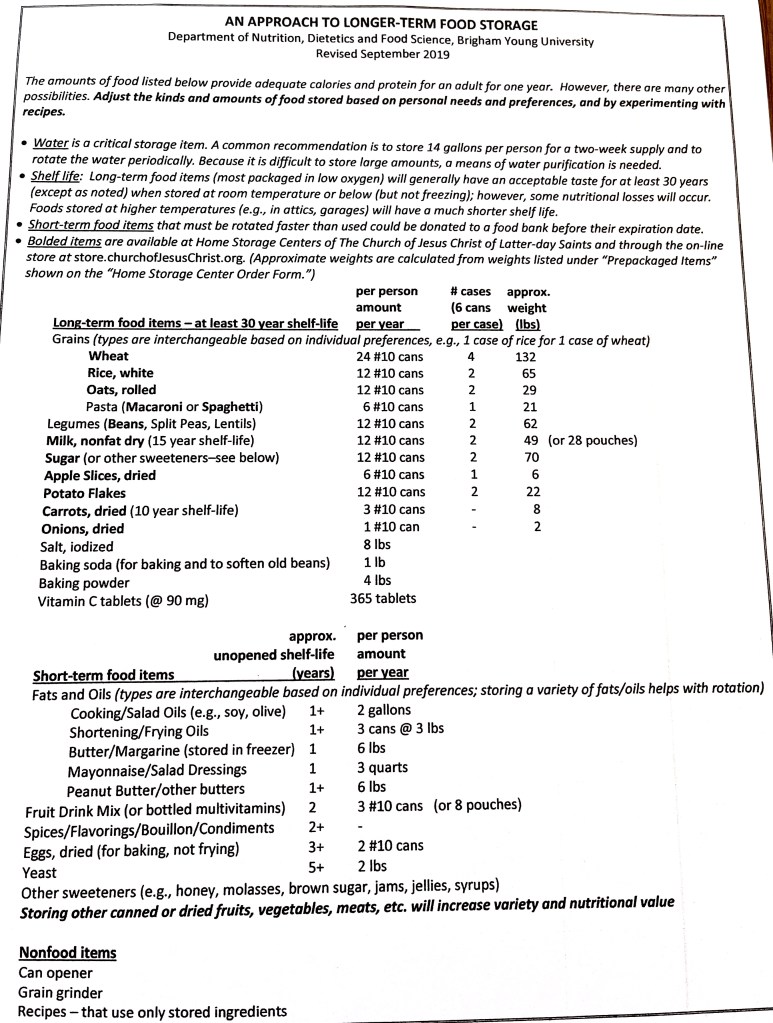
What am I supposed to have in my food storage? There are three main components of food storage:
Food supply (three-month and long-term)
Water supply
Financial reserve
Store foods that are a part of your normal diet in your three-month supply. As you develop a longer-term storage, focus on food staples such as wheat, rice, pasta, oats, beans, and potatoes that can last 30 years or more. Learn more about a long-term food supply.
How much food storage do I need?
Take the amount of food you would need to purchase to feed your family for a day and multiply that by 7. That is how much food you would need for a one-week supply. Once you have a week’s supply, you can gradually expand it to a month, and eventually three months.
For longer-term needs, and where permitted, gradually build a supply of food that will last a long time and that you can use to stay alive, such as wheat, white rice, and beans. A portion of these items may be rotated in your three-month supply. (See All Is Safely Gathered In.)
Where should I store my food storage?
Make sure your food storage is properly packaged and stored in a cool, dry place.
If water comes directly from a good, pretreated source, then no additional purification is needed; otherwise, pretreat water before use. Store water in sturdy, leak-proof, breakage-resistant containers. Consider using plastic bottles commonly used for juices or soda. Keep water containers away from heat sources and direct sunlight. Learn more about water storage and purification.
Self-reliance is a product of our work and undergirds all other welfare practices. It is an essential element in our spiritual as well as our temporal well-being” (Thomas S. Monson, “Guiding Principles of Personal and Family Welfare,” Liahona, Feb. 1987, 5).
How much does it cost?
Costs may vary depending on where and how you purchase your food storage. It is important to remember that you should not go to extremes; for instance, it is not prudent to go into debt to establish your food storage all at once. Develop it gradually to diffuse the overall cost over time so that it will not become a financial burden.
Why was the pamphlet produced?
To teach the simple principles of home storage and encourage participation. It offers hope by showing that it is possible for most Church members to prepare for adversity, starting modestly by storing a few items of food, filling a few leak-proof containers with water, and saving a few coins each week. The pamphlet helps eliminate the perceived complexity of home storage.
Where do I start?
Start by adding a few storable items that you typically eat, storing some water that is safe to drink, and saving some money, if only a few coins each week. Then, over time, expand these initial efforts—as individual circumstances allow and where permitted—by storing a longer-term supply of basics such as grains, beans, and other staples.
How quickly should I obtain my food storage?
It is not prudent to go to extremes or go into debt to establish your home storage all at once. Gradually build reserves over time as financial resources and space permit.
How often should I rotate stored products?
Continually use and replenish the food in your three-month supply to avoid spoilage. You may wish to rotate into your regular meals elements of your longer-term food supply. Such items can, however, if properly packaged and stored in a cool, dry place, last 30 or more years. See the Home and Family section of the Church’s website, ChurchofJesusChrist.org, for more information about home storage rotation and packaging.
What about 72-hour kits?
Church members are encouraged to prepare for adversity by building a basic supply of food, water, money, and, over time, longer-term supply items. Beyond this, Church members may choose to store additional items that could be of use during times of distress.
End Of Actual Doctrine from Church Website.
Where does Faith come in?
Self Reliance wording seems to sound like we depend on ourselves but the truth is, being self reliant means we actually have faith in Christ and trust and rely on his teachings and by obeying his word, we are able to provide for ourselves. We know that our blessings all come from HIM. Continual prayer, scripture study and service keep us balanced and centered and one with God’s will and inspiration.
We know it’s a commandment to continuously work on getting the basics, but what are your why’s? I’ll go first:
My why is that I eat like a teenage boy and don’t want to be hungry. I’m also here because my food storage is so so random and I have no idea how long my family could survive on it. I want to learn to prepare more food with it but use food that is actually healthy and that we eat. I freeze dry several times a week and have a pretty decent supply of long term storage, pantry food and water but I want to keep it growing all the time for myself and who may need it. I know I have holes in what I need to make certain meals and I actually have never thought about complete meals and how it would work. I feel like I could never have enough stored but I know I have what I have been asked to store.
Emergency preparedness was a difficult concept for me in my younger years because there simply was not enough extra. No extra money or room in my little apartments. But mostly, I didn’t eat a fraction of the foods that were traditionally stored and I felt like I if I had to eat them, my health would be damaged. So I am determined to make it healthier and accessible for myself and anyone who cares to have help getting going. It will take a lot of research for me this year but I am willing to do the work with you to figure out solution through prayer and study. I want to be prepared for whatever I can be prepared for and I want to leave the rest to the Lord and not worry. I want to be in a position to not only help myself and my family, but anyone else that the Lord decided to use me as an instrument to help. Remember: If ye are prepared, ye shall not fear.
Why is important to you and how prepared would you like to be? How much do you care?
Call to Action: what is your focus this month?
Mine: I bought a bunch of glass jars of all sizes. I am not slacking on running my dryer every other day. Change out water in barrels. I am going to heat seal boxes of Spaghetti and some bags of grains with oxygen absorbers so they last longer.
Tip: I heard you can use a hair straightener!
I am going to focus on freeze drying my frozen food that is about to be freezer burned.
Please look up recipes that you think are great or modify your own foods into food storage friendly and text them to me as often as you can. I will print out and add to your notebooks.
Next week:
The importance of health in food storage and dietary restrictions and intro to methods.
Notes: (please screen shot and text me so I can add more info for others)
1. Food, Water, Snacks, Desserts
We are going to leave this to you to make your own list but start with your sever favorite meals x4 and have months worth on top of your random storage. Make sure to add chia and flax and micro greens.
2. Power, energy, heating, cooling
- A network of neighbors, ward members, family and friends with a power out plan. Everyone has certain skills, assignments and abilities. Use proximity to create a web. Ex: engineer, welder, wood worker, mechanic, plumber, electrician, seamstress, doctor, counselor, teacher, baker etc…
- a network of cast iron pans and skillets
- bike, bike parts, cart
- bags and containers
- wood items
- tin foil (windows will absorb heat when no ac)
- homemade ice cooler (we will figure the details in a future class
- outdoor solar camp shower with privacy
- solar cell charger
- walkie talkies/landlines
- batteries ( odd sizes too)
- generators… multiple and multiple kinds.. and test often
- fuel (ways to store in future class) and propane
- wood stove
- fireplace
- brikets
- matches
- lighters
- camping stove
- terra cotta candle and other home made heat sources ( we will investigate)
- wood
- timer, analog clock
- compost toilet/outhouse and tp options
- solar panels
- roof and drywall repair
- small plumbing/heating/cooling and thermostat repair
- new kinds of fire extinguishers
- safety pins and sewing kits
- smoke detectors and carbon monoxide detectors
- glass containers
- plastic water jugs
3. Cleaning supplies and tools
- baking powder and soda
- vinigar
- apple cider vinigar
- alcohol
- bleach
- basic tools x2
- basic yard tools x2
- chain saw
- several can openers and heavy duty scissors
- twisty ties all forms of tape and glue
- many forms knives and sharpeners
- wheel barrow , hoses and basic gardening tools and containers
- contractor bags, kitchen bags, groceries bags, freezer bags
- masks and gloves
- DW-40
- Dish soap, liquid hand soap, bar soap, concentrated cleaner, stain removers, Castile soap
- flat iron, milar bags,
3. Hygiene/ Medical/Herbs and Supplements/ Cosmetics/ infant care and women’s health
- snake or spider bite kit
- CPR and first aid products, training and quick guides
- many bandages, prescriptions
- T.P. sanitary wipes, pads, tampons, birth control
- washcloths, old towels, cheese cloth and flour bag towels
- floss, toothpaste, brushes, instrument to clean your families teeth, mouthwash
- lotion, body soap, razors, deodorant, sunscreen
- clippers, tweezers x2
- many extra contacts, glasses, contact solution
- life-straw bottles
- herbs, essential oils (oregano, basil, peppermint, hellichrism, ginger, tea tree, frankincense, lavender, Digestzen (Doterra)
- meds like cold and flu, cranberry pills, charcoal, Tums, Pesto
- vit D, magnesium and potassium, CBD, aloe plant, pain killer, valerian root, melatonin, calcium lactate, birch oil
- diapers, wipes, rash cream
- Waxalene, pine gum salve, Burtsbees, coconut
- pest control supplies
- hair cutting set
- things specifically for your use (heel lift, arch support, moleskin, hearing aides)
Entertainment, office supplies, art and craft supplies, books, education
- prints out of art to copy gets inspiration from
- art supplies, watercolor, craft paint
- tons of paper, pens, eraser, paper and manual sharpeners
- office supplies
- balls
- books on how to and fun stuff (DK and Kingfisher)
- cards, games, puzzles
- sewing stuff
- sharpies, thin and thick
- paint brushes
- recipes and substitutes printed out
- firebox
-
Survey
Figure out where you are in the following survey:
Food Storage Survey
What’s best describes you right now? Circle all that apply.
A) I’m doing great with food storage and don’t really need help. I feel confident in what I’ve done and what I am continuing to do.
B) Help! I’m overwhelmed and confused. Draw me a picture and then maybe I can do this?
C) I could care less right now with everything else I have going on.
D) I can barely afford groceries, hygiene products and cleaning supplies as is with these crazy, rising prices.
E) I think it’s important but my spouse does not, so I feel alone in the work and the expense.
F) I think it’s ridiculous and don’t feel the need to be a “prepper”. Makes me feel like a doomsday/ crazy person.
G) I’m interested in the bare minimum that the church has specifically outlined so that I feel like I’ve at least followed the prophet. I have faith that I’ll survive and don’t care to go beyond that.
H) I for one, do not feel like living on sugar, flour and beans. I’d like to take it well beyond the commandments. I want to work towards having a couple year storage of a variety of foods I enjoy, not to just barely survive miserably on. Plus I would love to have enough hygiene, cleaning supplies, and other items that are important to me.
I) I need other women to bounce ideas off of, gather usable recipes and meal plans, motivate me to be consistent in my efforts and feel like I have a sisterhood and network of information and possible trade as things are becoming increasingly complicated in the world. A like minded group of friends is just what I need!
J) I’d like food storage if it was healthy and unprocessed and actually relativity fresh. I don’t want to buy food I don’t eat and usually eat mostly fresh.
K) I realize I spend money on unnecessary expenses weekly and I would like to invest more in this area of my life.
L) I’m a food storage rockstar (or close to) and want to share my knowledge and continue to prepare and learn more.
What other ways would you describe where you are at on the matter?
What would you like me to research and teach you to save you time? Or what do you want out of these classes/activities/handouts and group efforts?
PLEASE DISCUSS THIS IN THE CLASS
Are you or someone local you know (member or not) amazing in at least one area of food storage or emergency preparedness? Would you be willing to teach us or ask them to? Don’t be humble please… now is not the time! You can even just share a name. Example: water storage, sale prices, low waste, gardening, 72 hour kits
1. Food, Water, Snacks, Desserts
We are going to leave this to you to make your own list but start with your sever favorite meals x4 and have months worth on top of your random storage. Make sure to add chia and flax and micro greens.
2. Power, energy, heating, cooling
- A network of neighbors, ward members, family and friends with a power out plan. Everyone has certain skills, assignments and abilities. Use proximity to create a web. Ex: engineer, welder, wood worker, mechanic, plumber, electrician, seamstress, doctor, counselor, teacher, baker etc…
- a network of cast iron pans and skillets
- bike, bike parts, cart
- bags and containers
- wood items
- tin foil (windows will absorb heat when no ac)
- homemade ice cooler (we will figure the details in a future class
- outdoor solar camp shower with privacy
- solar cell charger
- walkie talkies/landlines
- batteries ( odd sizes too)
- generators… multiple and multiple kinds.. and test often
- fuel (ways to store in future class) and propane
- wood stove
- fireplace
- brikets
- matches
- lighters
- camping stove
- terra cotta candle and other home made heat sources ( we will investigate)
- wood
- timer, analog clock
- compost toilet/outhouse and tp options
- solar panels
- roof and drywall repair
- small plumbing/heating/cooling and thermostat repair
- new kinds of fire extinguishers
- safety pins and sewing kits
- smoke detectors and carbon monoxide detectors
- glass containers
- plastic water jugs
3. Cleaning supplies and tools
- baking powder and soda
- vinigar
- apple cider vinigar
- alcohol
- bleach
- basic tools x2
- basic yard tools x2
- chain saw
- several can openers and heavy duty scissors
- twisty ties all forms of tape and glue
- many forms knives and sharpeners
- wheel barrow , hoses and basic gardening tools and containers
- contractor bags, kitchen bags, groceries bags, freezer bags
- masks and gloves
- DW-40
- Dish soap, liquid hand soap, bar soap, concentrated cleaner, stain removers, Castile soap
- flat iron, milar bags,
3. Hygiene/ Medical/Herbs and Supplements/ Cosmetics/ infant care and women’s health
- snake or spider bite kit
- CPR and first aid products, training and quick guides
- many bandages, prescriptions
- T.P. sanitary wipes, pads, tampons, birth control
- washcloths, old towels, cheese cloth and flour bag towels
- floss, toothpaste, brushes, instrument to clean your families teeth, mouthwash
- lotion, body soap, razors, deodorant, sunscreen
- clippers, tweezers x2
- many extra contacts, glasses, contact solution
- life-straw bottles
- herbs, essential oils (oregano, basil, peppermint, hellichrism, ginger, tea tree, frankincense, lavender, Digestzen (Doterra)
- meds like cold and flu, cranberry pills, charcoal, Tums, Pesto
- vit D, magnesium and potassium, CBD, aloe plant, pain killer, valerian root, melatonin, calcium lactate, birch oil
- diapers, wipes, rash cream
- Waxalene, pine gum salve, Burtsbees, coconut
- pest control supplies
- hair cutting set
- things specifically for your use (heel lift, arch support, moleskin, hearing aides)
Entertainment, office supplies, art and craft supplies, books, education
- prints out of art to copy gets inspiration from
- art supplies, watercolor, craft paint
- tons of paper, pens, eraser, paper and manual sharpeners
- office supplies
- balls
- books on how to and fun stuff (DK and Kingfisher)
- cards, games, puzzles
- sewing stuff
- sharpies, thin and thick
- paint brushes
- recipes and substitutes printed out
- firebox
-
Subscribe
Subscribed
Already have a WordPress.com account? Log in now.
 Site Title